
Fast Five: Victor Tong ‘26GS on how Hands-on Sustainability Experience Shaped his Future
Victor Tong ‘26GS shares how the Dual BA Program equipped him with the tools to turn his passion for environmental policy into a future career.
Welcome to Fast Five: Rapid-fire, insightful interviews with GS students and alumni!
For Victor Tong ‘26GS, the Dual BA Program provided the perfect, unique experience to study environmental policy at two universities renowned for their programs. After a fruitful civic engagement project (Parcours Civique), where Tong volunteered with the Youth Conservation Corps in Hawaii, he realized that adopting a sustainable development major at GS would be the ideal pathway to actualize his lifelong aspirations.
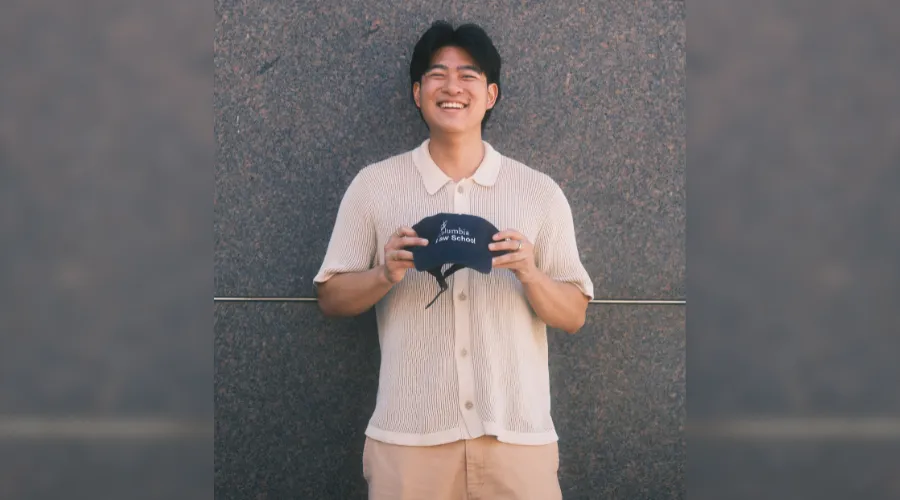
This past summer, Tong interned at the Sabin Center for Climate Change Law, learning as much as he could about the growing field of climate law. That passion led him to apply to Columbia Law School where he was recently named a LEAD Fellow and will continue his education there in two years time.
What is the senior the most proud of during his time in the Dual BA Program? His experiences with the two universities’ debate societies, which allowed him to travel the world and land among the top 10 university debaters in the United States last year. With graduation on the horizon, we asked him to share more about what he’s working on and what’s to come!
Tell us your GS story in one sentence!
I joined GS to study environmental policy at two of the world’s most renowned universities for their climate and sustainability programs, with the goal of preparing myself to address complex environmental challenges through policy.
How has the program shaped your academic interests and/or long-term goals?
The Sciences Po Dual BA includes a Parcours Civique, or civic engagement project, which allows students to serve in public-facing roles while writing a comprehensive research report on their experience. Through this component, I had the opportunity to volunteer with the Youth Conservation Corps in Hawaii, where I engaged in hands-on conservation fieldwork in one of the most biodiverse regions on Earth. I gained experience working in local watersheds, forests, and ridgelines.
This Parcours Civique experience inspired me to major in sustainable development at Columbia and has significantly shaped the career path I hope to pursue.
What's been your favorite class so far?
My favorite classes at Columbia have been Energy Law and Climate Change and Law, both taught by Professor Michael Gerrard and cross-registered with Columbia Law School. These courses allowed me to study alongside current law students and helped me assess whether I wanted to pursue a legal career. My experiences in these classes deepened my interest in the intersection of environmental policy and law and motivated me to continue exploring this path.
I later had the opportunity to conduct research with Professor Gerrard and intern at the Sabin Center for Climate Change Law during the summer of my junior year. I published reports, briefed cases, and learned to conduct legal research at a professional level. This experience ultimately inspired me to apply to law school, and I was fortunate to be accepted as a LEAD Fellow at Columbia Law School, where I plan to concentrate in environmental law.
I initially took these courses as a personal challenge, and I am grateful to have had the privilege to actualize that aspiration at Columbia.
How do you balance your academic, social, and personal commitments at Columbia?
One underrated piece of advice for balancing academic life at Columbia is to make time for office hours. I have learned so much from my professors outside the classroom, and their guidance has shaped everything from my research interests to my personal life.
I also recommend taking full advantage of being an undergraduate in New York City. There are countless opportunities and perks, including unique study spaces when you need a change of scenery. My favorite place to study during finals is the Met, along with other museums that offer free admission to Columbia students.
What accomplishment during your time in the program are you most proud of?
I had the opportunity to travel to Madrid, Bulgaria, Vietnam, Panama, and the United Kingdom with both Columbia and Sciences Po's debate societies. I debated competitively in high school, and both programs offer extensive, competitive debate coaching and training. My debate partner and I ended up ranking in the top 32 teams in the world two years in a row, and we both finished in the top 10 university debaters in the United States last year!